Showing posts with label Animal Rescue. Show all posts

Wednesday, June 27, 2018

The Dangers of "Free to Good Home" are Worse Than You Think


People sell or give away their pets for a variety of reasons. The most common reason include:

  • The family is moving and can't take the pet with them
  • A couple just had a new baby and the pet is no longer a priority
  • The pet is "untrainable"
  • The pet was the child's responsibility and he/she is not taking care of the pet
  • Someone in the family is allergic to the pet
  • The pet parent passed away
As hard as it is to believe, I have even seen an ad selling a Great Dane because he was too big.

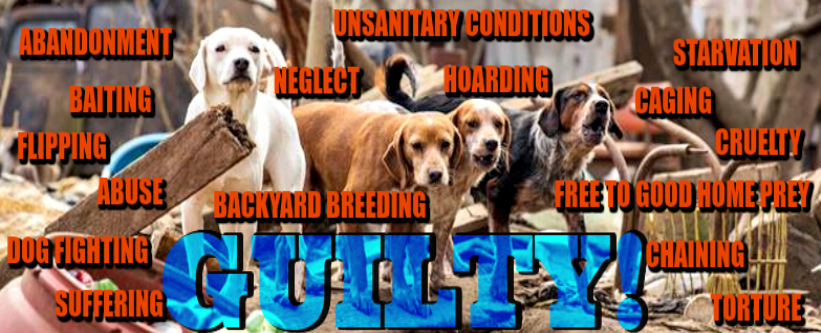
Craigslist and social media sites have made selling and giving away pets much easier. It has also created a hunting ground for people with nefarious reasons for wanting to "adopt" a pet. One of those nefarious folks is called a "flipper". They pose as a person very interested in adopting a free pet and appear to be a good home.  Once they have the animal in hand, they quickly "flip" the animal, selling them for cash to the highest bidder. They don't care if the animal is going to a good home, all they see is the cash.

Flippers don't confine themselves to pets. Free horses are frequently sold to slaughter for good money.

Another hunter of free animals, particularly kittens and small animals like rabbits, guinea pigs, hamsters, etc are snake owners. All of those pets listed make a free warm meal for larger snakes. Sometimes the snake owners will be "kind" enough to adopt all of your litter. You may think "Why not? Its less I have to worry about." How would you feel if you saw this on Facebook?

Its shocking, but important to see. 

Free small (and sometimes larger) dogs are often used as bait dogs to train fighting dogs. Dog baiting usually involves tying a dog to a fence or pole and releasing the fighting dogs to tear the bait dog to shreds. In some areas this is a sport, although it is illegal. Some are even bold enough to post it on Youtube.

Free pets are even adopted by people with the sole intention of abusing the animal. In a recent case, a man bought kittens off of Craigslist in Alabama to later stomp them to death in his kill room.

While Craigslist claims that pets cannot be sold on their website, they do allow pets to be adopted with a "rehoming fee". To many that's just another word for "sold". There is no regulation of the amount of the rehoming fee. In an interview with ABC 7 News, the U.S Department of Agriculture claimed it has been "cracking down on online pet sales over the past couple of months". They also said that they are" requiring online breeders to have a federal license" but told  ABC 17 News that "they can't regulate Craigslist pet sales."

Craigslist and Facebook sale pages have become the most common way for backyard breeders and puppy mills to not only sell their animals, but take those free pets who are not spayed or neutered, and use them for breeding. This doesn't mean that they live in loving homes and only are bred as "nature intended". These animals can be locked in cages, sleeping on their own feces, and taken out only to breed and give birth. Although the seller may claim that the puppies have been dewormed and vaccinated, often they are not and once you get the puppy home, he or she may soon die of common preventable diseases such as parvo. Unscrupulous breeders may also remove and sell the puppy before he or she should be weaned, so that they new pet parent will think they are getting a miniature toy puppy.

This also happens with pig breeders. Very few pigs sold as pot bellied pigs are actually pop bellied pigs. Instead they may be hog piglets that have been taken from their mother early. In a few months, you will be left with a 200+ lb hog that ready to root (dig with the nose). He or she will dig up your carpet, dig up your garden, and generally make a mess of things. Unaltered pigs, particularly males become increasingly aggressive. When this happens, what will you do? The breeder certainly will not take the pig back.


Locally,  I often see ads saying "must get rid of today", "first come, first served", "will be taken to the shelter if not adopted today." These words are nothing but bait for these exploitative hunters. They are indeed the hunter, and your pet is the prey.  


For me, perhaps the most shocking pet hunters and flippers are for-profit "rescues".  Non-profit rescues have all their animals spayed or neutered, dewormed, and vaccinated. They also have the proof that it was done. They carefully screen potential adopters, do home visits, and have a contract stating that the pet must be returned to the rescue if he or she is unable to remain with the adopters.
For-profit "rescues" are just an unethical pet store by another name and they will sell the pet as soon as possible and for as much money as they can get. Again, they have no concern where your pet will go.

It costs money and time to become a non-profit, so becoming a 501c3 non-profit rescue or sanctuary is something flippers are usually unwilling to do. Non-profits must report that money coming into the rescue is used for the upkeep of the animals, vet visits, supplies, food, litter, etc.  For-profit "rescues" can pocket the money and run.

If you really want to find a good home for your pet, the following are guidelines are a good start:

  • NEVER adopt on a first come, first served basis or say you "must get rid of today." Prepare in advance. Its the least you can do for your pet.
  • NEVER offer the pet for free. Ask a rehoming fee of at least $25 for dogs or cats.
  • NEVER guilt someone into adopting by saying the animal will go to the shelter tomorrow unless he or she finds a home. These placements rarely work out. 
  • Have the potential adopter fill out an application before they come meet the animal that also serves as a contract that the animal will not be sold for profit, baiting, or experimentation. Include questions on the application such as will the pet be kept indoors or outdoors? Do the potential adopters have a fenced in yard or will the pet be kept on a chain or in a kennel?  Are there any other pets in the house. How long has the other pet lived with the family? Are there any children in the family?
  • Get vital information including name, address, phone and drivers license number. Refusing to give this information can be one indication that the adopter may not have the best of intentions. 
  • Ask for references. Vet references are preferred. Inquiring on the care of other pets in the home can help the pet parent decide if the potential home is a responsible one. Ask if the pets are up-to-date on vaccines and if he or she is neutered or spayed. 
  • Check with the landlord to see if the potential adopter is allowed pets
  • Insist on a home visit. When there, observe how the other pets are treated. How do the children and other family members interact with your pet.  Also note if the application was filled out truthfully. 
  • Give an honest impression of your pet or your pet may find its way to the animal shelter before long.  If you pet is not potty trained for instance, tell the potential pet parents. Never adopt a pet that does not get along well with other pets or children with homes that have one or both. 
  • Offer the rehoming fee back once the pet is spayed or neutered. Sometimes, those looking to breed will be unwilling to spay or neuter.
While these guidelines may seem like too much, your pet deserves the best home you can find. You owe him or her that much. 

Some areas are forming groups that weed out and report the names of flippers, backyard breeders, those convicted of animal cruelty, and for-profit "rescues". They monitor Craigslist and Facebook for sale pages noting who are frequently adopting and reselling animals that are free to good homes.

Locally, you will find the group  Animal Lovers Against Back Yard Breeders of East Tennessee on Facebook. Their purpose is "for East Tennessee animal shelters and rescues to help keep their DNA (Do Not Adopt) lists current. We will expose known dog flippers, backyard breeders, & those known for cruelty & neglect." Consider starting a similar group in your area.

For more information on pet adoption, pet health, and important animal related information, see


Monday, April 2, 2018

The Power of Pack Love

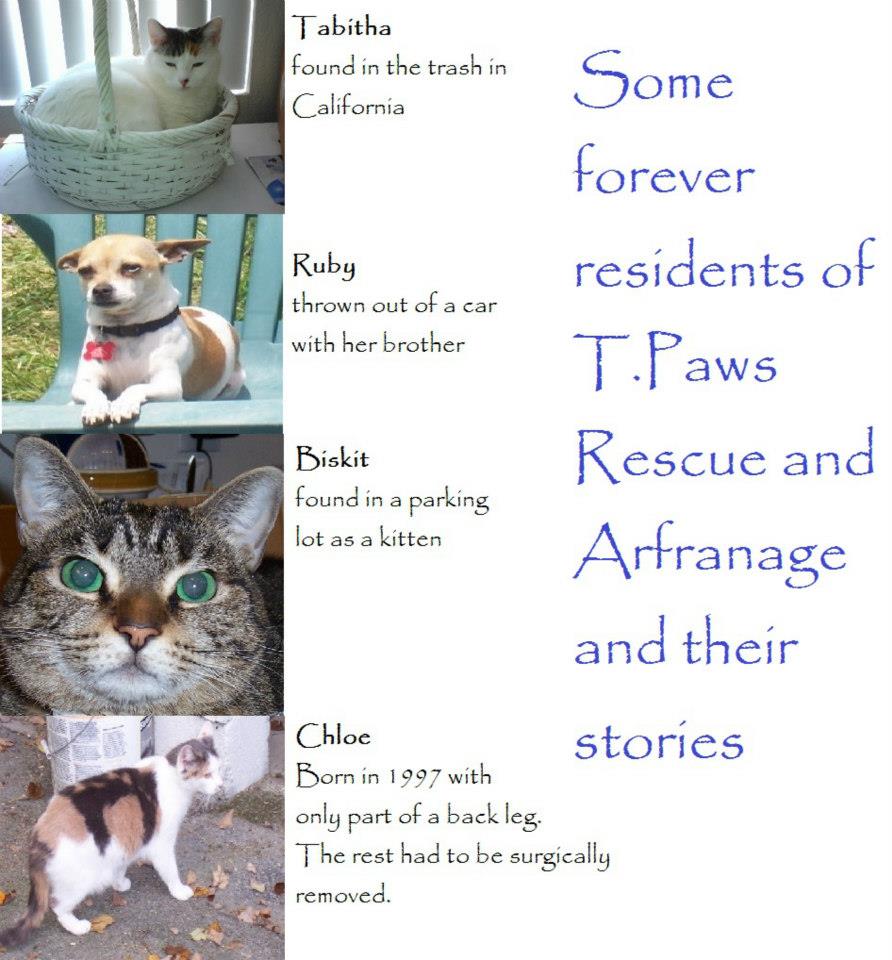
Its been a long time since I last wrote, but for a good reason. T.Paws Rescue & ARFanage became Tiny Paws Sanctuary for Special Needs Animals. We are now a non-profit organization dedicated to those who have been neglected, abused, or have just grown old and need special medical care.

When I speak of "special care", it can mean many things. It can be physical damage caused by cruelty. Jeffery came to Tiny Paws when he was rescued from an animal cruelty case. Most of his teeth were falling out and x-rays revealed that he had a hip dislocation and knee fracture that was never treated. His knee cap was turned inward and his hip joint found itself a new home. It was very difficult for him to walk. The injuries were too old to fix, but with pain management, he can run.

Sarah was another that required special care. She was blind. She was not born blind, but developed glaucoma, a condition that causes pressure to build inside the eyeball itself. The eye expands, much like a balloon if left untreated. It had been recommended a few years ago for Sarah's eyes to be removed, but the owner didn't follow through. So her eyes continued to expand until, much like that balloon, they ruptured. Once that occurred, she was out of pain. She came to Tiny Paws to avoid euthanasia.
Sarah

Sometimes those special needs may be genetic. Elsie was born deaf. Little did we know, she also had asthma. When part of our ceiling collapsed from a small leak that had built over time, the dust and insulation triggered a severe asthmatic reaction. Thanks to our vet and a week in the hospital, she was saved. However, x-rays revealed that she has an enlarged heart as well.

Age is certainly a factor that creates a special need. Our pets live longer these days, and with longer lives come conditions that we rarely saw before. Ruby was diagnosed  as few years ago with canine cognitive disorder as I mentioned in an earlier article. CCD is similar to dementia or Alzheimers. Before she was medicated, Ruby became very fearful. It seemed that she didn't recognize me. She would run under the bed and growl as if I was going to hurt her. Thankfully, medication has lessened her symptoms. She still needs a very predicable routine, particularly in the evening.
Elsie

Emotional damage from past abuse can also create a special need. Bo is probably the most clear example of that. The experience of living most of his life caged in a puppy mill left him very fearful of people and also created some behavioral issues. When he first came, he wouldn't let me get near him. I have to catch him with a slip lead in order to get him to the vet, give him flea prevention, or trim his nails. Since he had to live in his own feces and urine, crate training was out of the question. Barking seemed to be his soothing behavior.  I have worked to build Bo's trust in me for the last five years. He will now eat out of my hand and he's realizing that he likes to be petted. I can pick him up but he runs for the corner and crouches in the corner expecting punishment. I'll keep working with him until he expects love.
Bo

Special needs animals require a lot of medical care. Last year, our medical costs were over $8000, and unless something changes, we will exceed $10,000 this year.  However, there is one other factor that I have learned is imperative in a sanctuary of special needs pets, and that is the power of pack love.
Ruby

The power of pack love is not something I invented. The pack taught it to me. Dogs, in particular, need a pack. The pack is their family and gives them a sense of security and contentment. They know what is expected of them and what their role is. The younger dog learns from the older dog, or in our case, from the dogs who have lived here longer. When a new animal comes in, I step out of the equation for a while. I have learned it is much easier for the other dogs to communicate to the new arrival that they are safe here.

Goldie came to Tiny Paws not long ago. She suffered from glaucoma much like Sarah. Over the years, I've learned who is calm upon meeting another dog, and who is not as calm. Since she only had vision in the right eye, I only introduced her to the older and more handicapped dogs first. That pack I refer to as Abigail's pack. Sarah was a little concerned about meeting them, but the others sniffed her and went back to bed. I gave her a couple of days to get used to the older pack, and then moved on to the younger group I call Teddy's pack, who stay in a different bedroom. I introduced her out in the dogs' play yard one by one. Just like Abigail's pack, they were interested, said "hi" and went about their business.
Goldie

In order to take all the dogs out to potty (except Sarah and Jeffery),  they all have to go through the dining room (which is not used as a dining room, but more space for the dogs).  The walk through that door to the dining room intimidated Goldie so much. She simply wouldn't go. So I remained at the half-door between the two rooms and called for Ruby, who was already outside. She came in and I had her go to Goldie and then turn around and head back towards me. Goldie followed her. It took repetition of this same scenario before she confidently went through the door and out with the other dogs. I didn't teach Goldie, Ruby did. I didn't give Goldie confidence, Ruby and the pack did. I just operated the door. Once the time came to have her eye removed to relieve her pain, she was not shy when she came home. She went out with the others, and it was obvious that she was now an established member of the pack.

If you've read any of my books Secrets of a Vet Tech I or II, you know about the daily howl. The daily howl was started by Teddy several years ago. Depending on the anxiety in the house, Teddy or Bo will begin howling. Then one by one the others join. It may last a short time, or it may last several minutes. When it is over, there is a calm and contentment among the entire pack. Bo, who has barked all day and is filled with anxiety, can finally rest. Those who had grappled, make peace.  The daily howl bonds them as a family and it is really the voice and a demonstration of the power of pack love.  


Wednesday, May 15, 2013

The Saga of T.Paws Vet Adventures and How to Manage Your Pet Dollars.


Thanks to some hard thinking and ingenuity, I am able to take care of eleven dogs (and 8 cats and a bearded dragon)  for probably less than what most people spend on one. Here, is a little insight on how I manage it and also a reminder that its Rabies Month in Tennessee!!!

In Tennessee, May is Rabies Awareness Month. Rabies is an acute infection of the brain caused by a virus.  It is usually transmitted from wild animal to unvaccinated pet and then to human. We have been able to make it a rare issue by mandatory vaccination.

Some states require the vaccine every year, while others require it every 3 years. There is no difference in the vaccine, however, the states make the decision based upon the possibility of exposure. For instance, in Tennessee, we live very close to wildlife. Many of us live in the mountains among the forest. While some states allow you to give the vaccine yourself, Tennessee is not one of them. So in Tennessee it is required once yearly to be given by a veterinarian.

The good news is that Rabies Clinics are offered all over the state this month at a discount. A rabies clinic may be held at a local Tractor Supply or feed store. Some veterinarians will pick a Saturday and spend the day giving rabies vaccines. Other vets, like mine, Mount Carmel Pet Hospital   is simply honoring the price all month long. You have no idea what a blessing that is for multiple dog owners.

(For availability in your area, check with your local humane society and check with your vet to see what they will be doing.)

I've decided to use the month as my vaccination month. I vaccinate my own pets for all other diseases, so that's what I did this month. However, I did it a week before I had them vaccinated for rabies simply to reduce the chance of vaccine reaction since most of my dogs are chihuahuas.

I also gave most of my guys a little dose of benadryl (1 mg/lb of body weight) prior to leaving for the vet. This helped them stay a little calmer and also helped to prevent vaccine reactions. 

Since I have 11 "forever" dogs at my rescue, T.Paws, being able to take a few at a time was very helpful. I started out with 3 who had skin issues (Tinker, Blue, Athena) and Ms Ruby, my "right hand dog", who insisted on going.  We discussed the cause, the doctor's recommendation, and cost. They are well aware of the financial challenges I face and are excellent at helping me prioritize and talk things through. I also had the doctor check Tinker's hernia which has been repaired once, and we talked about the possible outcomes of not having it repaired again. I also asked about Ms Ruby's teeth (which they looked at from afar :). She had just had a dental last year, but the tarter was horrible, so dental costs were discussed.  And we talked about the possibility of Blue having a thyroid problem. Then those guys were vaccinated and went home.

Next came Casey. She is my golden retriever mix. She is also absolutely terrified of storms, riding in the car, fireworks, and slippery floors. Dealing with 4 scared chihuahuas is a breeze compared to dear sweet Casey. Not only did she go for rabies, but also to get acepromazine, a common sedative for dogs who are not prone to seizures (it can lower the seizure threshold). Getting there and getting the exam was easy. Even getting the vaccine was a breeze. Getting home was CRAZY! She was so stressed when we got home, she took a sedative and so did I. I was done with rabies shots for that day!

Since the others only needed their rabies vaccine, my dad came over the next day and I had the rest of the clan in two crates. Teddy and Scrappy in one. Pearl, Onyx, Bo, and Panda in the other. We loaded it on the truck and off we went. Teddy was happy to see everyone as he had visited them not long ago, and, being Teddy, wanted to show "his" pack around (he takes his position as the official spokesdog of T.Paws very seriously). Everyone was weighed and vaccinated, and it was a very pleasant visit. Not to mention they loved the ride in the truck.

Here's where money management comes in. As I always do, I put it on the CareCredit Card. As I have mentioned before, this card is a healthcare card that gives me (usually) six months interest free to pay it off.

With a big group like I have, and little money to work with, I try to think ahead and plan on doing one thing a month. In January for instance, I might buy several months worth of Fipronil for fleas even though I don't need it. February, I might purchase extra food, March, vaccines, and so on. So now that I know that Ms Ruby needs a dental, Tinker needs hernia repair, Blue may need blood work, my goal is to put the money I would have been using for flea control (but already bought in January) into my CareCredit and get it paid off.

The doctors both agreed that Tinkers hernia repair needs to be first. So that is what's planned next. Some vets will give you discounts if you have multiple animals having a procedure on one day, so don't be afraid to ask).

But by spreading out the costs of the needs of my animals, using the techniques in Secrets of a Vet Tech , utilizing CareCredit, taking advantage of special discount months, and being completely open and honest with my veterinarian, I am able to take care of more animals for less than some spend taking care of one. And THAT is the secret of living as a rescue here at T.Paws.

Tuesday, March 12, 2013

We Need You! Fostering & Transportation Trains


Fostering isn't exactly a good way to save money, but it saves something more important: LIVES.

Its also the least we can do for animals who show such unbelievable unconditional love.

Normally when I tell people I foster, they say "Oh, I could never do that. I would keep them all."
Boy do I understand that!!! Its hard to let go.

I started fostering almost two years ago. During that time I have been able to foster and adopt out through a local humane society more than 30 animals. Now think about that. That's 30 animals that didn't have to die.

I'm not saying that to toot my own horn, I'm saying look what one person can do.

Sometimes these animals need only a few more days, maybe a few more weeks to find a home. Shelters are so overcrowded they do everything they can to avoid euthanasia, but where are all these pets to go?

The internet has helped.  Networking using methods like Facebook has helped. Shelters in the south are sending adoptable animals north. Breed rescues are being contacted from all over. Pilots for Paws are flying pets to new homes. A series of volunteers are driving pets all over the country to rescues. Petfinder.org is connecting pets in little ol' Southwest Virginia to the Big City!

The frustrating thing to shelter/rescue folks is knowing how many animals could be saved if three things happened:

1) People would spay and neuter their pets so there wasn't an overpopulation problem
2) More folks would open their homes and hearts to foster
3) Volunteers would step up to transport animals to new homes or rescues.

I've talked about spaying and neutering in other blogs, so lets focus on the other two. First, what does it mean to "foster"? Fostering usually is simply giving a dog/cat/small animal etc, a place to stay while a new home is found. Because of overcrowding, shelters can only give a pet so many days. For owner surrendered pets, that is usually between 3-5 days. If they have room, most shelters will keep them longer, because they, more than anyone, hate putting adoptable animals to sleep. But the reality is, there are very few uncrowded shelters.

So fostering gives them that time they need. Usually fostered pets will go up on Petfinder.org by the rescue you are fostering for, and normally, they will cover your expenses including food, vet care, etc. They will often ask you to bring the pet to adoption events to give folks a chance to meet him/her. You can specify what type of pet you can handle. For instance I specialize in small breeds like chihuahuas because I know I can integrate them with my other pets much easier. In the summer when it is warm enough, I might be able to take a larger dog because I have outdoor kennels.

You might prefer to foster cats, a couple dogs at a time, or maybe just one big dog. Its up to you.

I won't lie to you and tell you it doesn't hurt letting them go to a new home. But that hurt is worth knowing you saved their lives. I don't know about you, but I think that's worth it. Often the new family will be happy to send pics showing how great your little friend is doing. That's when it feels amazing!

Now the next thing that is desperately needed in animal rescue, are volunteers willing to transport pets. A dog in South Georgia may get adopted by a couple in Maryland. So, animal rescuers (who are wonderful and resourceful people) will set up a "transportation train". Volunteer A will drive Fluffy from the animal rescue to Chattanooga. Volunteer B picks up Fluffy in Chattanooga and drives him to Knoxville. Volunteer C picks up in Knoxville and drives to Wytheville, VA and so on.

If you love road trips, its an awesome thing!

Animal rescue is an emotional way of life, no doubt. Its not always easy. For those of us who are deeply into it, there is a saying. "You may lose your mind, but gain your soul".

But the thing is, you can get involved in small ways that make a HUGE difference. Contact your local humane society, SPCA, or rescue and see how you can get involved.

Because they can't drive themselves

Local contacts if  you are interested in helping transport pets:

 kathyboje @ gmail.com and
on.a.mission.from.dog@gmail.com